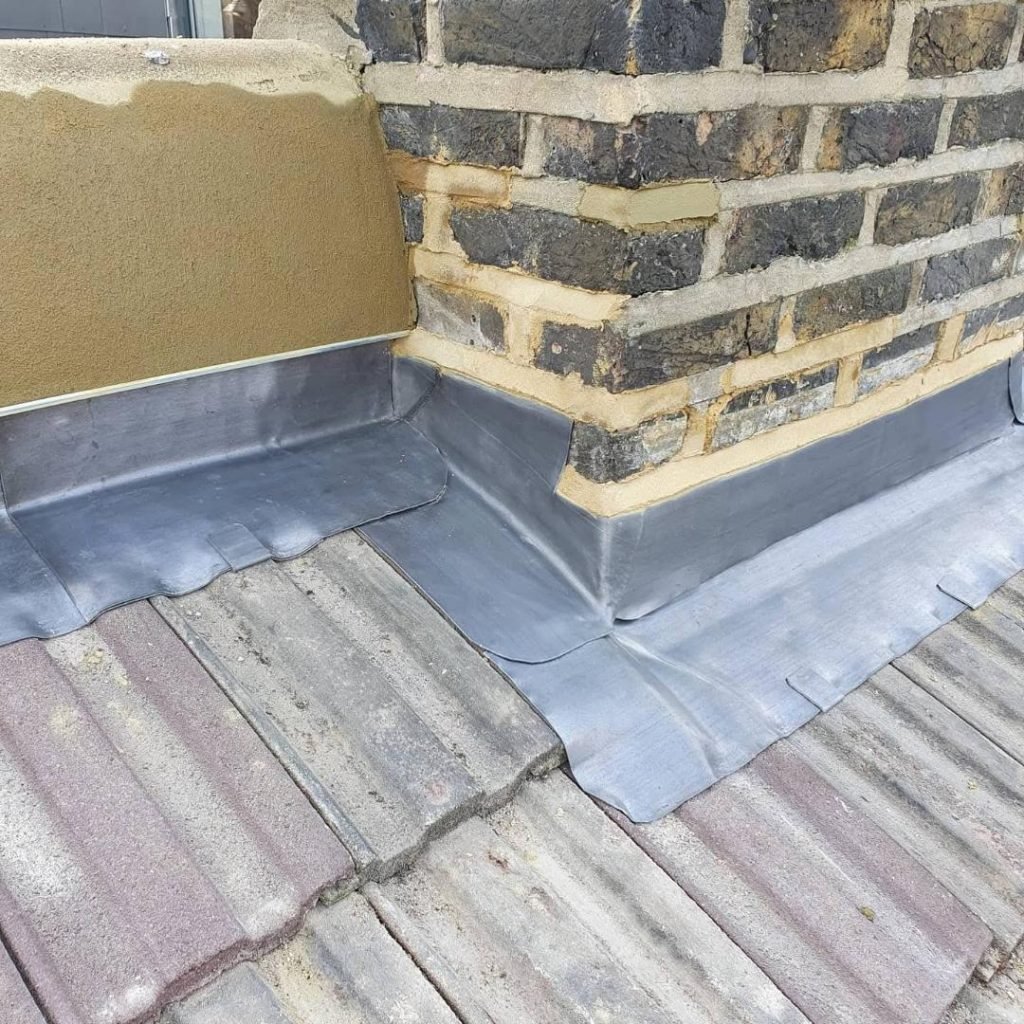
Our team carried out this Lead Flashing Repair Kilkee project on a property in Kilkee, County Clare.
The work focused on one of the most important weatherproofing details on any roof: the point where the chimney meets the roof covering.
As you can see from the finished project, new leadwork was carefully formed around the base of the chimney and dressed to follow the profile of the existing roof. The purpose isn’t simply to make this area look tidy. The lead needs to direct rainwater away from the vulnerable junction between the masonry and roof covering.
That’s particularly important for properties around Kilkee and the Clare coast, where roofs can be exposed to strong winds and wind-driven Atlantic rain.
This was a focused roofing job, but it’s exactly the type of repair that’s worth getting right. A relatively small defect around a chimney can allow water into the roof structure and eventually cause much more expensive damage inside the property.
A chimney creates a natural interruption in your roofing system.
Your roof tiles or slates are designed to shed rainwater down towards the gutters. The chimney breaks up that continuous surface and creates several junctions where water could potentially get underneath the roof covering.
That’s where lead flashing comes in.
Properly installed leadwork weatherproofs these junctions and directs water back onto the roof covering rather than allowing it to penetrate between the chimney and roof.
Problems can develop when older flashing becomes loose, damaged or poorly sealed against the chimney.
For homeowners, damp or water staining around the chimney breast can be one of the first signs that something isn’t right.
When we’re called to inspect a suspected chimney or flashing problem, we don’t automatically assume that replacing a visible piece of lead will solve the leak.
The complete area needs to be checked.
We typically look at:
This is important because the location where you see damp inside your home isn’t necessarily where the water originally entered.
Water can travel along roofing materials, decking or structural timbers before becoming visible internally.
Finding the source of the problem should always come before deciding on the repair.
For this Kilkee project, new lead was carefully shaped and dressed around the chimney and existing roof profile to create a durable, weather-resistant junction.
This is where experience with leadwork matters.
The lead needs to accommodate the shape of the roof covering while also turning up against the chimney. Corners, edges and changes in direction require particular attention because these are areas where water can find its way into the roof if the detailing isn’t right.
The finished leadwork creates a protective barrier around the base of the chimney while allowing rainwater to continue down the roof.
Lead has been used for roof weatherproofing for generations, and there’s a good reason it remains common today.
Sheet lead can be carefully formed and dressed around complicated roof details, making it particularly useful around:
However, homeowners should understand that using lead doesn’t automatically mean a roof junction has been correctly weatherproofed.
The quality of the installation matters just as much as the material.
Correct sizing, positioning and detailing are essential if the flashing is going to perform properly over the long term.
Location matters when repairing a roof.
Kilkee sits directly on County Clare’s Atlantic coastline, meaning properties can experience conditions that are considerably more exposed than those further inland.
Strong winds combined with heavy rainfall can drive water against chimneys, roof junctions and other exposed areas.
That’s why we pay particular attention to:
A roof doesn’t need to be completely failing to develop a leak.
Sometimes the problem comes down to one relatively small junction that is no longer preventing water from entering the property.
Lead flashing problems aren’t always obvious from ground level.
There are, however, some warning signs homeowners should pay attention to.
These include:
If you’ve noticed any of these problems, it’s worth having the roof inspected before assuming the entire roof needs replacing.
Often, a relatively localised problem can be addressed before it causes more extensive damage.
No.
This is an important distinction.
Water appearing around a chimney can certainly be caused by failed lead flashing, but there are other possibilities.
Problems can also originate from:
That’s why we’re cautious about telling a homeowner they “need new lead flashing” without inspecting the roof first.
The objective should be to identify the actual route water is taking into the property and fix the underlying problem.
Simply applying sealant to the area where water appears isn’t always a proper long-term repair.
Not every flashing problem requires complete replacement.
If the existing lead remains in good condition and the problem is confined to a particular area, a targeted repair may be perfectly appropriate.
Replacement can make more sense when:
From a homeowner’s perspective, repeatedly paying for temporary patch repairs rarely makes sense if the underlying flashing detail is wrong.
We’d rather properly diagnose the problem and explain whether repair or replacement provides the better long-term solution.
This Lead Flashing Repair Kilkee project is a good example of the specialist roofing repairs we carry out throughout County Clare.
Complete Roofing Construction provides:
If you’re experiencing a leak or other roofing problem elsewhere in the county, learn more about our roof repair services in Clare.
You can also explore our wider roofing services.
For homeowners around Ennis with a flat roofing problem, we’ve also created a detailed guide to flat roofs in Ennis.
For this project, the important part wasn’t the size of the job. It was making sure a vulnerable part of the roof was properly weatherproofed.
The new leadwork was carefully formed around the chimney and existing roof covering to help direct rainwater away from the junction and reduce the risk of water ingress.
For homeowners in Kilkee and throughout County Clare, our advice is simple: don’t ignore a small leak around your chimney.
What initially appears to be a minor leak can eventually lead to damp insulation, damaged ceilings, deteriorating roof timbers and more expensive repairs.
If you’re experiencing a roofing problem, Complete Roofing Construction can inspect the roof, identify the likely cause and recommend an appropriate repair rather than automatically suggesting unnecessary replacement work.
If you’re also improving the exterior of your property, our sister company, Complete Paving Works, provides professional driveway, patio and paving services across Clare, Limerick and Galway.
Free Quote
Call us for a free roof inspection and honest advice. Local roofers with 25+ years of experience across Clare, Limerick, Galway and Tipperary.